



Welcome to Deinfluencing Month! For the next few weeks, we’ll be digging into some of the biggest viral health trends that the algorithm is constantly promoting to people as they enter perimenopause and beyond. We’re connecting with vetted experts to help you know what these things actually can do, can’t do — and the contextual “why” of their ubiquity.
Is there a health trend you’re seeing everywhere and want to know more about? Leave a comment!
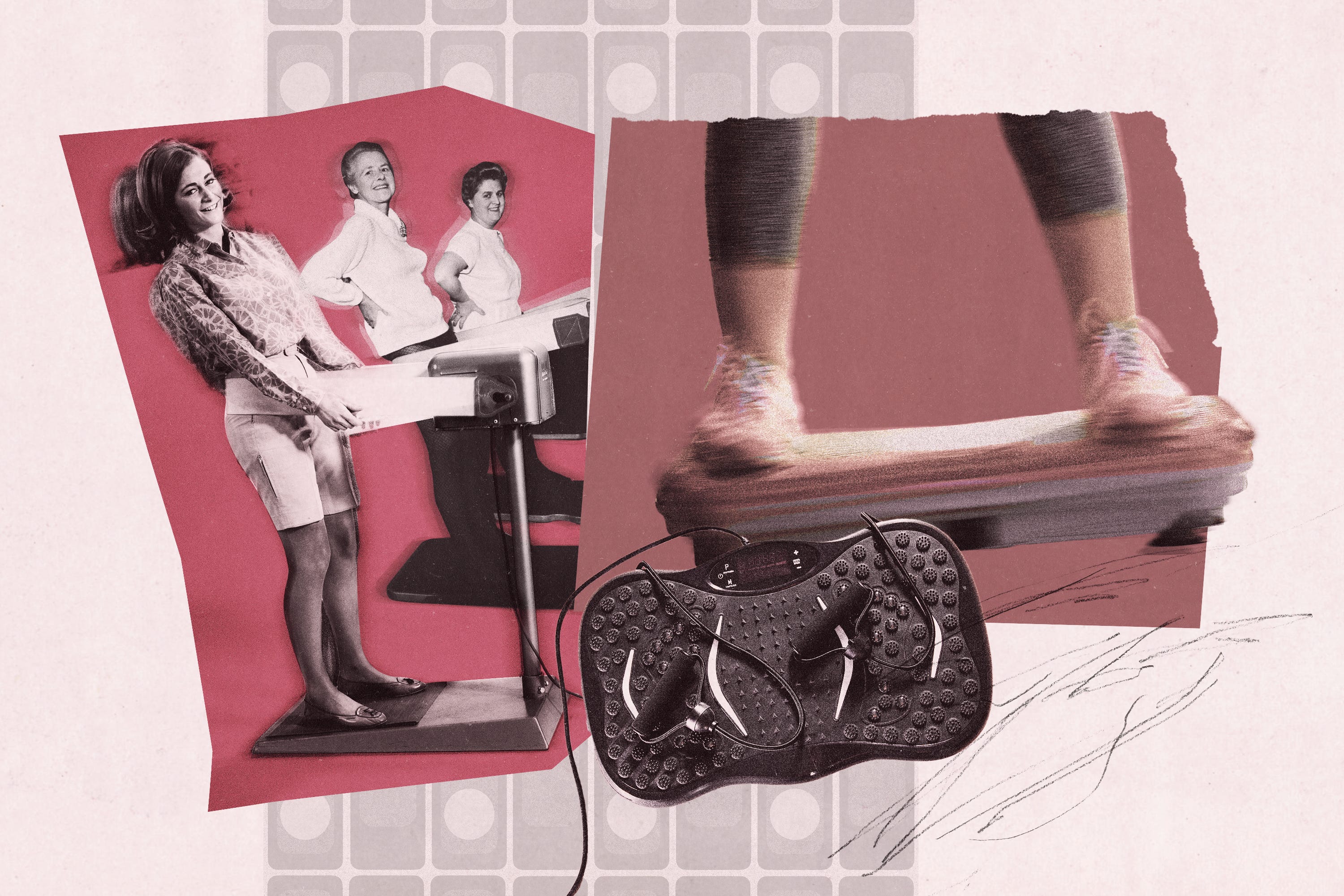
If I open Instagram, I’m virtually guaranteed to see some woman standing on a vibration plate, insisting that she’s shaking her metabolism back into the compliant, fast-paced state of her youth.
She’s burning fat! She’s getting rid of pesky cellulite! She’s definitely making claims about bone density and lean muscle mass! And I don’t really know what’s happening but she’s saying something about lymphatic drainage.
With so many claims about a machine that typically retails for less than $150 and requires only 10 to 15 minutes of daily use, it almost seems too good to be true.
I needed to find out why so many women are trying to quite literally shake off their age. I also wanted an answer to my forever question: Wait, am I supposed to be doing this too?
Cue expert #1
First I called Dr. Michael Fredericson, the founder of Stanford Lifestyle Medicine, which is all about digging into the science of healthy aging. He’s a professor of orthopedic surgery and medicine and is a co-director of the Stanford Center on Longevity and is also the head team physician for Stanford’s track and field and swimming teams. In other words, he’s no stranger to training and results.
And what he told me is that you could use a vibration plate if you wanted to — but to think of it as “the sprinkles on the icing on the cake” of choices to support bone health, lean muscle mass and balance — three of the factors essential for healthy aging.
“If the goal is to build bone density, you’re going to get much more benefit from just doing traditional resistance training,” Fredericson said. “You can get some additional benefit from vibration plates, but it’s pretty modest. It’s not going to take you from osteoporosis to non-osteoporosis.”
The same goes for balance work.
“If you’re doing balance work on the vibration plate, it’s sort of another challenge to your balance.” So can it help? Sure. But is it the only way? Not at all.
Stand on one leg; do it with your eyes closed if that’s too easy. You could also stand on a pillow, barefoot on plain grass or on a Bosu ball — all just as, if not more, effective ways to incorporate balance challenges into your exercise routine.
Vibration plates also are certainly not a replacement for lifting weights or doing body weight exercises that help keep bones strong and lean muscle from atrophying. He said they can boost blood flow to muscles and help with stretching but also “there’s so many better ways to do that.”
Static stretching — or, holding a muscle stretch for 10-60 seconds to improve long-term flexibility — is just as effective.
And a vibration plate doesn’t replace one of the most important things for your health, getting two total body strength workouts and at least 150 minutes of moderate aerobic activity a week.
Fredericson also pointed out that it can’t do something we know is definitely beneficial: take you outside. “Something about being in nature, outdoors, is just so much more powerful for you than just going to the gym.”
It also doesn’t address one of the other main components of healthy aging: social connection.
So, want to get aerobic activity, get outside and connect with others? Take a walk outside with a friend. No purchase necessary.
Cue expert #2
I also wanted to know how these vibration plates had even become a thing. I called up Danielle Friedman, the author of “Let’s Get Physical: How Women Discovered Exercise and Reshaped the World” and a journalist focused on the history, culture and science of women’s fitness.
Friedman told me that the vibration plates you’re seeing all over Instagram are far from a new trend.
“There is a long history of women turning to vibration, specifically with the goal of losing weight or losing fat,” she said, adding that throughout the 1970s and well into the 1980s, most gyms would have a vibrating belt in the women’s locker room. It’s a device that first started to gain popularity as early as the 1930s, when they were marketed to women as a way to “shape their figure.”
Throughout the 1940s through 1960s, she added, there were even national chains of “vibrating salons,” where you could secure a membership to go a certain number of times a week to allegedly “vibrate your fat away.”
We love (and hate) a quick fix
The other long-standing trend that the vibration plate of today speaks to, Friedman said, is gadgets that promise a quick fix. She’s fascinated by the moment these products are having right now.
“In the past, the focus was not so much on building muscle — it was just on fat, losing weight, shaping your figure. Now we’re in this moment, especially for midlife women, where we are bombarded with messages about protecting our muscle, our bones, navigating our hormones,” she said.
“We’re quick as a society to kind of turn our noses up at the ‘get fit quick’ solutions out there, but the reality is that so many women are struggling to find the time and energy to move and exercise and care for themselves in this way,” Friedman said.
It’s a situation that’s only exacerbated in midlife, when so many women’s lives are shaped by caregiving responsibilities, she said. All the sandwich generation-ing means that, on a practical level, women just don’t have time for exercise — and something being marketed as having some benefits in just 15 minutes a day is really appealing.
“We’re in this pendulum swing toward women just being bombarded with solutions or messages about how they need to care for themselves at this stage of life. We went from a place where perimenopause and menopause were completely overlooked and it was just like ‘deal with it,’ to now everywhere you look, if you’re in this demographic, people are offering solutions for your health,” she said. “It can feel so overwhelming.”
And a vibration plate? Well, it can feel convenient.
“You can hop on it while you’re watching TV or while your kids are playing or if you didn’t sleep the night before or if you don’t have the energy because you’re physically exhausted from child care or caring for others combined with whatever physiological changes you might be going through,” she said.
The quickness to judge women for engaging in a fitness-related activity rooted in efficiency feels convenient too, especially given how women disproportionately shoulder so many caretaking responsibilities and thus have less free time.
The mixed messages women receive — take care of everyone, look young, prioritize your health, don’t be selfish, don’t be stupid and taken in by a fitness fad — are as timeless as the vibration trend itself.
“It’s so frustrating because we’re told we have to look hot and there’s this anti-aging market for women in midlife that is just exploding, but there’s also sort of a little bit of a maybe cultural judgment about devoting time to it, especially when you could be caring for others,” said Friedman.
The real takeaway, she says, is simple — and judgment free: “Everybody benefits when women are able to devote time to moving their body in a way that feels good.”